
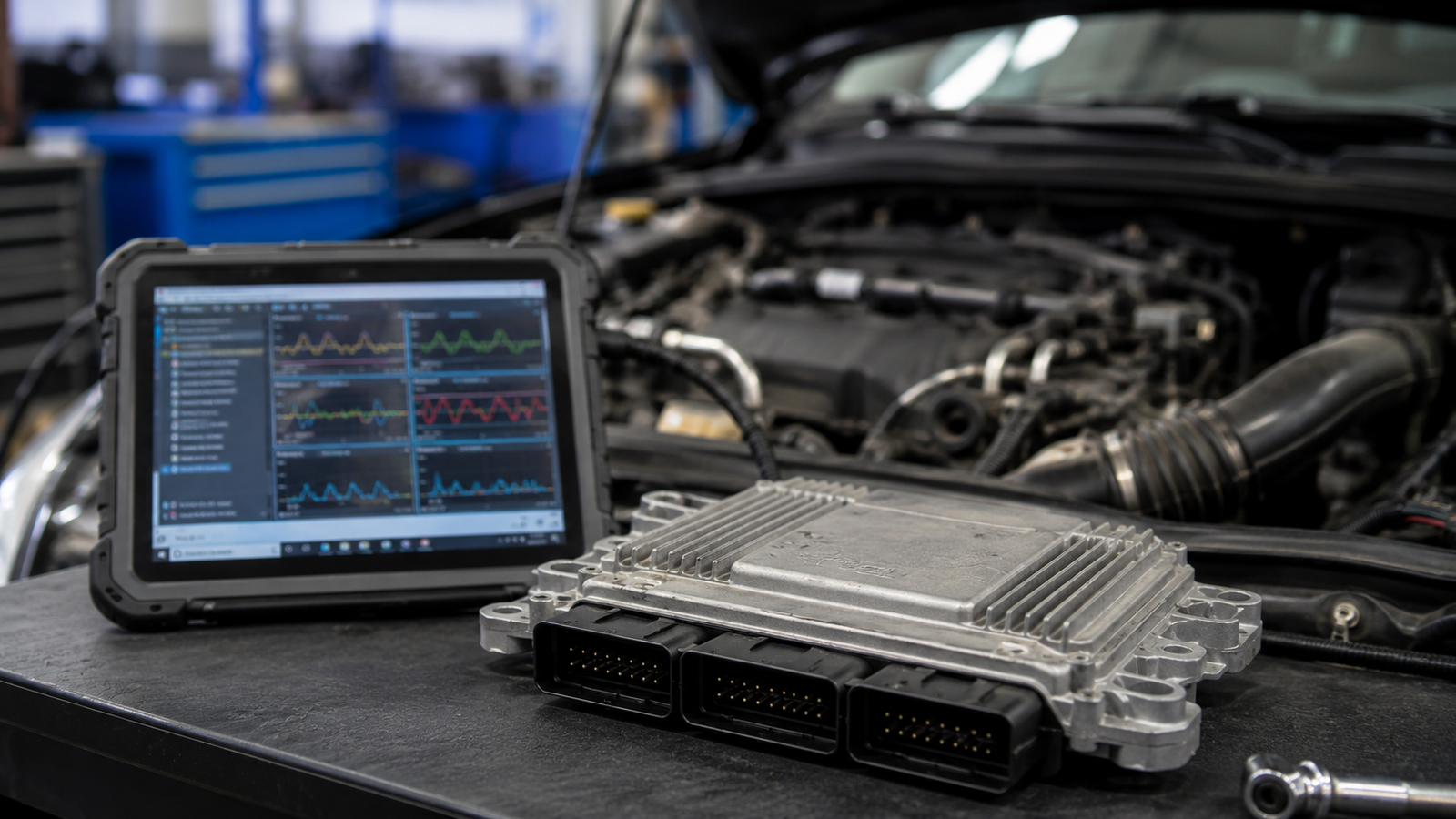
You are driving down the road, and suddenly your car loses power. The Engine Management Light (EML) flashes on the dashboard. You pull over, turn the ignition off, wait a couple of minutes, and restart the engine. To your surprise, it drives completely fine again—at least for a few days.
If you have been paying mechanics to chase a mysterious, intermittent misfire or an electrical glitch that nobody can seem to pin down, you are not alone.
When modern vehicles act possessed, the problem is rarely a mechanical broken part. Instead, it is usually a communication breakdown in your vehicle’s master computer: the Engine Control Unit (ECU).
Understanding the Engine Control Unit
Your ECU acts as the brain of your vehicle. Every single millisecond you drive, it processes thousands of data points from sensors spread across the engine. It calculates exactly how much fuel to inject, precisely when to fire the spark plugs, and how to keep emissions within safe limits.
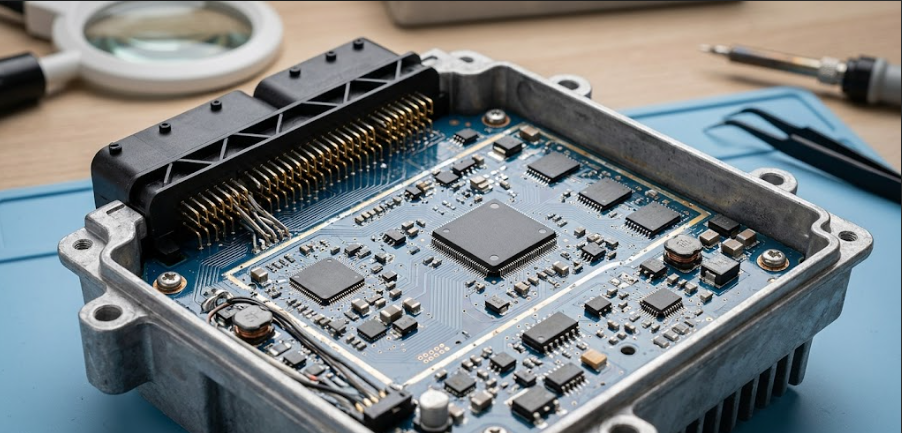
Because the ECU controls everything, a microscopic hardware failure or a corroded solder joint on the internal circuit board can mimic a massive mechanical problem.
Common Signs of a Faulty ECU
How can you tell if your car’s issue is a bad mechanical component or a dying brain unit? Look for these four common indicators:
-
Intermittent Misfires: The car drives perfectly, then suddenly stutters or drops into “limp home” mode before resetting itself after a power cycle.
-
No-Start Conditions: The engine cranks over perfectly fine, but it refuses to fire up because the ECU isn’t triggering the fuel pump or ignition coils.
-
Loss of Diagnostic Communication: When a garage plugs an OBD scanner into your dashboard, the machine displays a “No Communication” error, completely failing to read the vehicle’s computer data.
-
Spurious Dashboard Lights: Multiple warning lights (like ABS, Airbag, and Traction Control) lighting up all at once, despite those physical systems being completely healthy.
Avoid the Dealership Trap: Testing vs. Guesswork
When faced with complex electronic faults, many general mechanics and main dealerships rely on a costly practice known as “parts dart.” They will replace spark plugs, then ignition coils, then fuel injectors—charging you for parts and labor each time—only to find the problem returns.
If you eventually take it to a main dealer and they successfully diagnose the ECU, their default solution is a total replacement. This presents two distinct challenges:
-
Massive Expenses: A brand new, blank unit straight from the manufacturer typically costs anywhere from £600 to more than £1,500.
-
Reprogramming Delays: A brand new module must be coded and married to your vehicle’s security system, keys, and immobilizer, adding hours of expensive programming labor to your bill.
The Smarter, Component-Level Solution
At ECU Repairs, we use specialized testing environments to simulate real driving conditions on your module. Rather than guessing, our experienced engineers open the casing to locate and repair failed internal components, refresh damaged solder connections, and fix issues caused by water ingress.
By rebuilding your vehicle’s original unit, we preserve all your factory programming and keys. When your unit arrives back from our lab, it is entirely “plug-and-play”—meaning you save up to 70% compared to dealer costs with zero programming required.
Get a Reliable Diagnosis Today
Whether you are dealing with a faulty engine ECU, an airbag control module safety error, or body control (BSI/BCM) failures, continuing to drive with a malfunctioning unit can cause permanent damage to your electrical system.
Get an honest assessment from the UK’s trusted module specialists. Contact ECU Repairs today on 0800 043 6161 or email us at ecutestingandrepairuk@gmail.com to get your free diagnostic quote!